Archive for category: Blog

by

Voice-Enabled Mobile Search: The Differentiation You Need

The mobile commerce market is growing rapidly and playing an increasingly important role in any e-comemrce strategy.  The numbers are staggering.  The U.S. Retail Mobile Commerce market growing 70% last year to $42 billion, and forecasted to more than triple to $133 billion by 2018.  By 2018, mobile commerce will be 27% of all U.S. e-commerce sales.

Every e-retailer is taking a hard look at their mobile commerce strategy seeking ways to grow their share of the pie and differentiate in an increasingly crowded market.

Studies have shown that search plays a very strong role in the customer experience in mobile commerce.  The limited screen size and user interfaces on mobile devices push consumers to go directly to the search box to find the products they want on every mobile commerce site.

Voice-enabled mobile search is a tremendous way to differentiate from competitors through an engaging customer experience that will convert more customers and drive more revenue.

Please take a moment to watch our compelling voice-enabled mobile search video that can provide your mobile commerce site with the differentiation you need.


by

Poor Product Data? – No Worries!

Many people will tell you that your search and navigation is only as good as your product data.  However, derived attributes with natural language search and navigation now allows you to mask the problem of insufficient data in your product catalog and still deliver a rich search and navigation experience.

Derived attributes enable you to add extra navigation facets and search terminology when these attributes are not fields in your e-commerce catalog.  This saves you the cost of fixing or restructuring your product catalog when you want to deliver better search and navigation.

Also, from a customer experience standpoint, derived attributes can provide alternative ways for customers to shop on your site, creating a better shopping experience and allowing customers to find the right products faster.

Derived attributes are a feature unique to natural language site search systems such as EasyAsk.  They are defined easily using natural language rules.

The natural language rules derive the attribute values from any field in your product catalog and/or operational data from your e-commerce system.  When the search index and navigational facets are generated, the natural language rules calculate the derived attributes, extending the range of the index and facets.

The derived attributes can also provide unique merchandising and promotional capabilities.  Promotional rules can use the derived attributes to raise products or place products in special display blocks.  Andertons Music, who has a derived attribute named “Great for Beginners”, can use this attribute in promotion rules when they offer specials on music products geared for beginners.

Let’s look at two EasyAsk customers and how they use derived attributes: Andertons Music and The North Face UK.

Andertons Music

As mentioned above Andertons Music uses derived attributes to label specific products as “for beginners.”  This allows customers to search for things such as “beginner guitars” when looking for guitars geared for those just learning the instrument.  Customer can also select a navigational attribute called “Great for Beginners” when a person performs a more generic product search such as one for a specific instrument.  You can see this navigational facet in the screenshot below.

andertons-beginners-nav


In addition, since Andertons products cover a wide range of color types, some of which have complicated color names, they needed the ability to rationalize these colors into a palette more easily readable by the generic consumer.  Thus, they created a derived attribute for color, which you can see on the screenshot below, which takes these various color descriptions and presents them in a facet more understandable by the shopper.
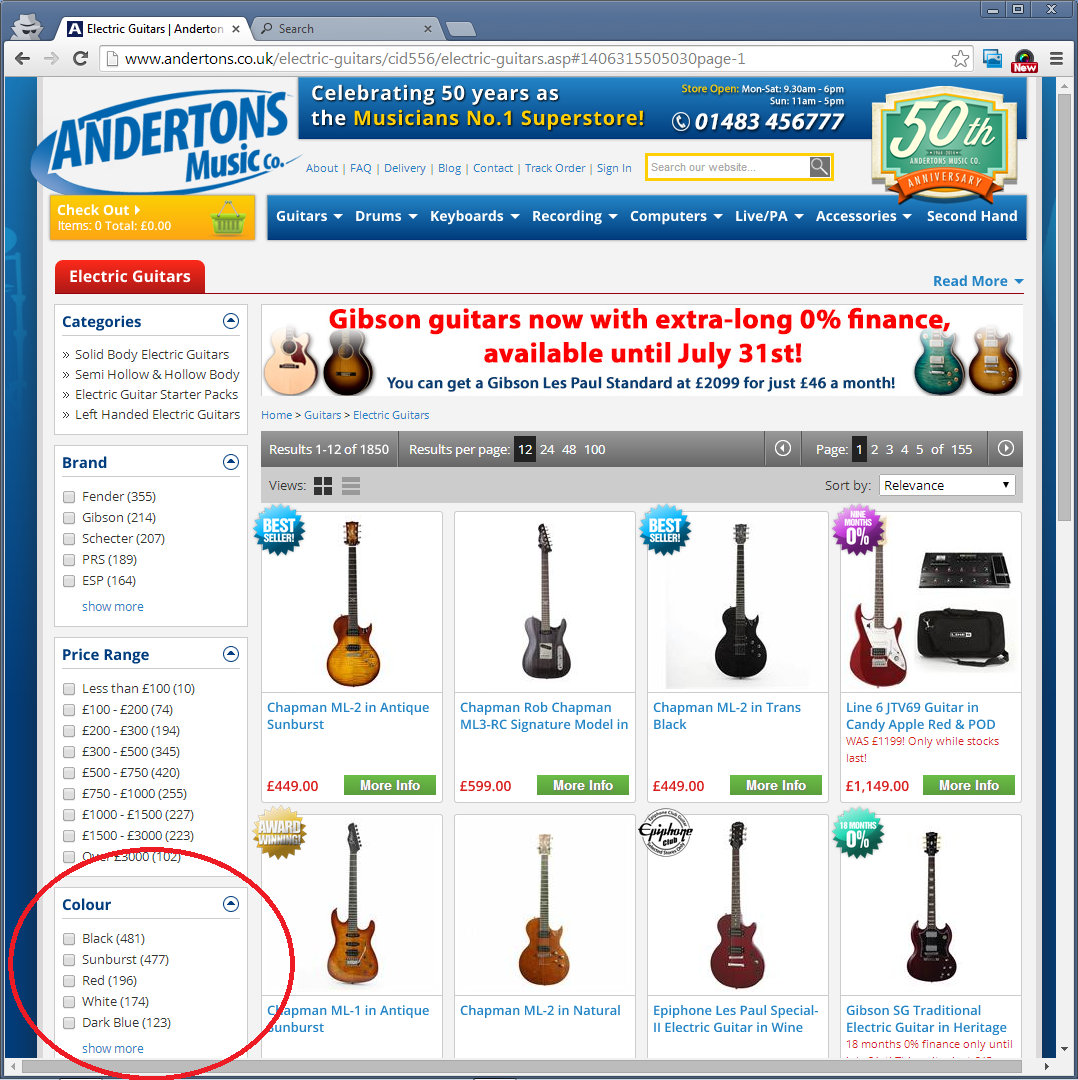
andertons-colour


The North Face UK

The North Face UK site also uses derived attributes to help describe the different technologies that go into some of their products, such as jackets.  This derived attribute is called “Technologies” and appears in the navigation after performing a search on products which include unique technologies.

This allows a sophisticated buyer who is looking for a product with that technology to find it faster on the North Face UK site.  In the screenshot below, you can see the Technologies navigational facet after I performed a search on “mens jackets”.  I can then narrow the results by selecting the technology I am looking for.  I can also use those technologies in my search, allowing me to search for “mens primaloft jackets” and get the exact results.

TNF-technologies


Derived attributes help you provide a unique shopping experience on your site without the high cost and complexity of re-organizing your product catalog.  In addition, the derived attributes are automatically applied to new products added to your catalog, which simplifies the launch and merchandising of new items.

To learn more about derived attributes and ways in which you can increase conversions through better product findability on your site, click here to receive our white paper Increasing Customer Conversion by Boosting Product Findability.

Also, contact the EasyAsk team to schedule a demo today, and we show you this unique feature and others that will lower the cost of maintaining your site and increase your customer conversion.

by

Online Merchandising using Special Display Blocks Part 2

We showed in Part 1 of this blog how to use natural language rules to drive special blocks for cross-sells and up-sells.  Special display blocks are a fantastic way to drive faster sales and increase orders sizes according to the EasyAsk white paper Increasing Customer Conversion by Boosting Product Findability.

What if you’d like to go beyond the typical special display blocks such as cross-sells and up-sells?  You could special display blocks such as:

  • “Featured Items” – display of specific items the merchandisers want to promote related to the search or product on display.
  • “Top Sellers” – display of products that have the most sales related to the search or product on display.
  • “What’s New” – display of the products most recently added to the catalog that related to the search, category or product on display.
  • “On Special” – display of products that are on sale or special price related to the search, category or product on display.

These blocks help you better promote products and provide greater flexibility to show products that are more in line with the visitor’s context – what they have been looking for or looking at.

The EasyAsk Merchandising Studio provides a direct method to drive a Featured Products block with any natural language rule.  The rule dynamically finds the products to display.

For example, an apparel retailer might want to feature products of a certain brand such as Cole Haan.  A simple featured products rule of “cole haan” will drive the featured products block to display the Cole Haan products.  This is much simpler to maintain that the approach of your typical e-commerce platform of hard-wiring products into special featured products groups.

EasyAsk natural language rules can use any product attributes from the catalog such as creation date/time for a What’s New block and a Sale or Special flag for a On Special block.  EasyAsk can also use operational data such as sales data for a Top Sellers block.

Since these rules are executed dynamically, the system will find the right products to display based on the current information in the catalog and the visitor’s context (what they are searching on, what category they are in, what product they are looking at, etc.).

Natural language rules will dramatically increase the flexibility of your site and speed promotions.  Your merchandisers will save valuable time in pushing out new promotions, and they can focus on what they do best – promote products.  This drives more revenue and speeds time to market.

You can learn more about using special blocks with natural language rules and other customer conversion tips in our white paper Increasing Customer Conversion by Boosting Product Findability.

by

The Most Intuitive, Intelligent, Natural eCommerce Search on the planet period!

Too much? Switch to decaf? OK, maybe. BUT when you’ve got a better mousetrap, sometimes you have to let the world know that you . . have a better mousetrap.

Here’s why. Some of you know, and many actually don’t, that there’s been an evolution in search. GOOGLE, the 800 pound gorilla of search, evolved (read abandoned) from simple keyword search to a much more intuitive semantic model. One more time: Google abandoned keyword search.

Why? It’s not very intelligent. Just matches words, without any understanding of what the user is actually searching for. MICROSOFT had previously engineered their Internet search engine, BING, as a Natural Language solution. Very effective, very efficient, very accurate. So neither of the two biggest players in Internet Search use keyword search anymore.

Which brings us to the world of eCommerce search. Why are YOU using an old, obsolete keyword search solution? You’ve been given a pretty good hint that, at best it’s … OK. When the objective of the exercise is to connect with shoppers and convert them to buyers, just how well your search works REALLY matters!

Enter EASYASK. That’s what we do. Natural Language search and merchandizing. We’re the best in the world at it and I’m not afraid to say it. Why? Because we actually understand what it is your shoppers are looking for.

We’ll take your old Solr keyword search and supercharge it like you won’t believe. We’ll kick your customer conversion into a whole new level. We’ll increase your eCommerce revenues through the roof. We’ve got the numbers and success stories to prove it. Here are a couple: upgrading from IBM Websphere Solr, The North Face U.S. rolled out their site on EasyAsk within 3 weeks and, within 2 weeks, found their customer conversion had doubled. Doubled in 2 weeks! Then The North Face Europe deployed on the Magento platform (9 countries, 5 languages), again Solr based, and found a 35% increase in search conversion rates and a 24% increase in revenue! Huge numbers for a company the size of The North Face.

But you don’t need to be that big to realize the benefits. We’ll get you up and running in a few weeks and you’ll see the results instantly. The beauty is that the real cost to your company is staying with what you’ve got. You’re leaving far too much money on the table through poor search and navigation. If your shoppers can’t find it, they’ll abandon your site. Let us help you serve up exactly what they’re looking for on the first page, every time!

We’ll save the tech pitch for another time. Send us a note, or give us a call and we’ll get your eCommerce revenue flowing.

Thanks,
Craig

by

Online Merchandising using Special Display Blocks Part 1

As discussed in the EasyAsk white paper Increasing Customer Conversion by Boosting Product Findability, customer eyes are always drawn to special display areas ion the browser, making them a fantastic way to promote products and drive more sales.

Many sites will have often used special display blocks such as “Related Items” for cross-sell promotions or “You Might Also Like” for up-sell promotions.  This capability is typically built into the e-commerce platform merchandising/promotion screen.

These promotions are easy to enable in your e-commerce platform, but are extremely difficult to manage there.  Why?  E-commerce platforms will force you to hard-wire cross-sell and up-sell relationships on a per item level.  When your site reaches hundreds of items or more, this process becomes time-consuming, unwieldy and costly.

Dynamic, natural language merchandising rules and an easy-to-use merchandising tool alleviate this merchandising problem and give greater flexibility for promotions and offers. The dynamic rules execute on the fly based on what the visitor is searching on, clicking on or looking at, determining the best products to place in the block(s) and increasing the click-through and conversion rates.

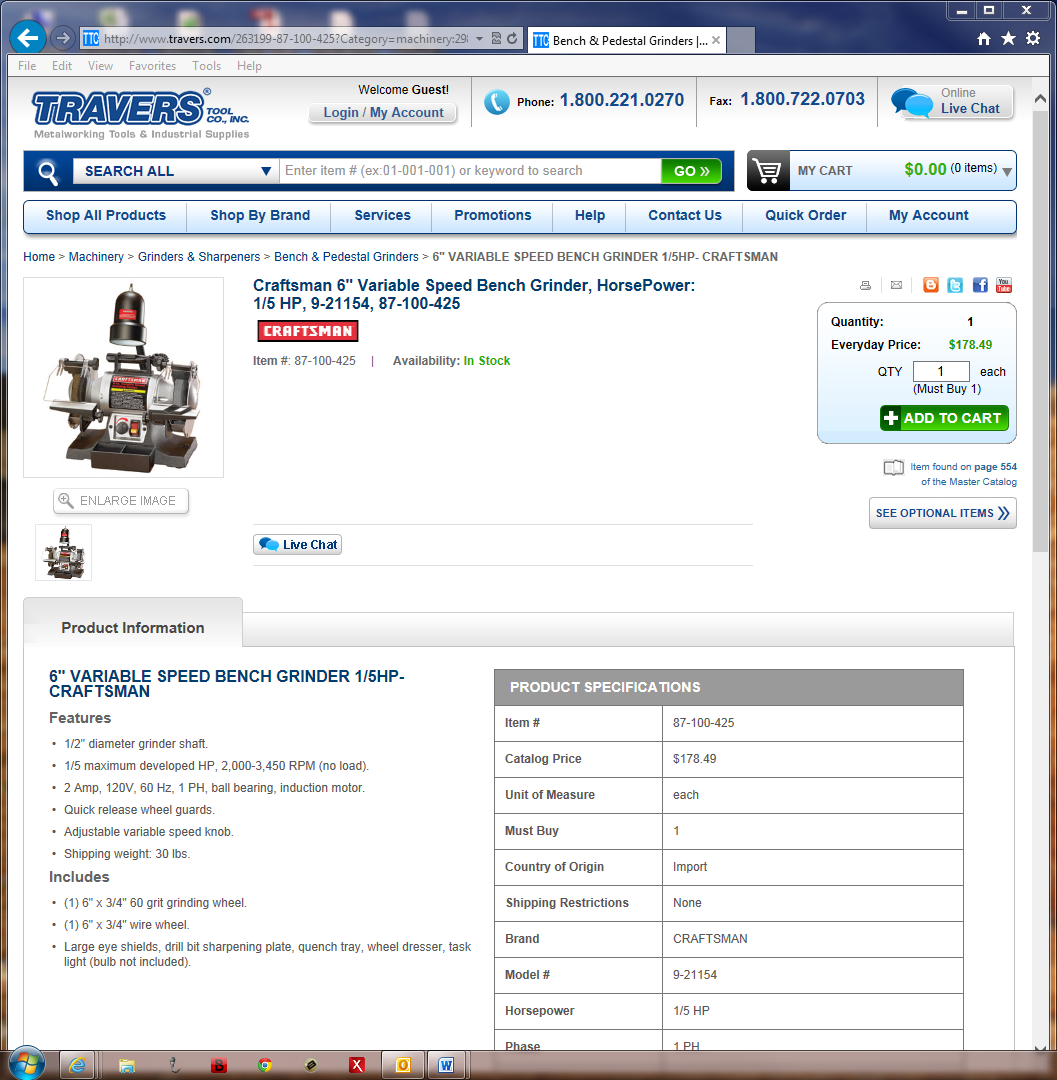
Let’s take a look at Travers Tool’s e-commerce site.  They use dynamic natural language rules, executed in real-time to fill into two special blocks on a product page: Optional Items and Recommended Items.  The first image is the top of the product page for a Craftsman Bench Grinder, and the second image shows the two special blocks lower on the page.

travers-blocks-1

travers-blocks-2


The Travers Tool site used a natural language rule to (a) understand the page is for a Craftsman Bench Grinder, and (b) relate in real time the optional products and recommended items.  Since the relationship is derived in real-time based on attributes, merchandisers do not need to hard-wire the relationships within each product entry in the product catalog.

This is a tremendous time saver for the merchandisers and reduces the cost to maintain the product catalog.

You can learn more about using special blocks with natural language rules and other customer conversion tips in our white paper Increasing Customer Conversion by Boosting Product Findability.

by

EasyAsk Announces Global Release of Magento Connector

We announced the global release of the EasyAsk Magento Connector this morning.  The EasyAsk Magento Connector enables rapid implementation and direct integration of EasyAsk natural language search, navigation and merchandising for Magento E-Commerce sites.

The EasyAsk Magento Connector:

  • Is integrated directly with the Magento product catalog and attributes, enabling using long-tail natural language searches, even those from voice input on a mobile device.
  • Seamlessly integrates into the Magento site display with no API programming for rapid implementation and easy change.
  • A dynamic navigation plug-in that supports the selection of multiple attributes for faster navigation to products by visitors.
  • Support for “derived attributes” that allow you to create new categories and attributes from existing Magento attributes without the time and cost of restructuring your Magento catalog.
  • Ties the easy to use EasyAsk merchandising studio to the Magento catalog and attributes for fast, easy natural language promotion rules.
  • Supports full internationalization and localization supporting Magento sites sites in different languages and countries including English, German, French, Dutch, Italian, Spanish & Portuguese.

Dozens of Magento-based sites are using EasyAsk for Magento including some of the largest Magento sites such as The North Face EMEA, Harbor Freight Tools, Watsco and Anna’s Linens.  As we announced last week, the North Face EMEA deployed EasyAsk across 11 sites across 9 different countries, seeing a 35% increase in search conversion rates and a 24% increase in revenue from search.

The EasyAsk Magento Connector is available for free to customers using the Magento e-commerce platform.

by

Promoting Your Best Products Online

When a customer performs a search or navigates to a category, the most important thing is to get the right products to the top of the page.  But what defines the right products?  They could be the combination of products that most accurately match the search and products you want to promote at this time which fall within the search parameters.

“Relevancy” is the most important feature in a search engine for accuracy.  EasyAsk’s natural language engine delivers far more accurate relevancy scoring through features such as phrase matching, column weighting/ranking and value-based relevancy to expand control over results and deliver better hit rates.  Read more on our earlier blog post on relevancy.

Your merchandisers also need the ability to adjust where products are displayed on an e-commerce site just like they would promote on the floor of a brick and mortar store. You may want to promote specific products based on:

  • Inventory – promote products with low stock for clearance, or products with high stock in order to jump start sales,
  • Margin – promote your higher margin products to improve profitability,
  • Brand – suppliers may give you incentives to promote specific brands, or you may find certain brands to be better sellers,
  • Product Age –promote older products to clear out the remaining inventory or promote newer products that might be more in season.

The results and category pages need to be driven by promotion rules that can take into account these different factors.
This is where natural language rules come into play. It allows the merchandisers to specify the priority of the products in the display in their own language. These rules also allow merchandisers to create “derived attributes” that create customer friendly ways to display and categorize products without the time and cost to re-design the attributes in your product catalog.

EasyAsk customer Andertons Music took advantage of natural language rules to better promote products on their e-commerce site (read the press release).

Promoting the most effective products is the third customer behavior use case in our new white paper: Increasing Customer Conversion through Better Product Findability. You can download this free paper and find ways to better tune your site to customer behavior.

by

The North Face Europe Uses EasyAsk on Magento

We were pleased to announce this morning as part of our continued partnership with The North Face® that The North Face Europe has rolled out EasyAsk eCommerce Edition for Magento on 11 different sites across Europe. This rollout delivers the customer conversion power of EasyAsk’s natural language search, navigation and merchandising to each of these sites.

The North Face Europe has already seen fantastic business results from this rollout – a 35% increase in search conversion rates and a 24% increase in revenue from search. EasyAsk was deployed in 9 different countries and the accompanying languages including: UK, Germany, Netherlands, Sweden, France, Italy, Spain and Austria. The North Face had already deployed EasyAsk eCommerce Edition in the United States and Canada.

The internationalization and localization features of EasyAsk truly shine in the rollout at The North Face Europe. We offer many thanks to the team at The North Face Europe for allowing us to share this great news with our community.


northface-uk-site

by

Search-as-you-Type completely transforms your search box into a sales box

Once upon a time the search box was a mundane rectangle sitting in the upper part of an e-commerce site.  It served a purpose and sites that recognized the need for good e-commerce search enabled their customers to find what they were looking for.  Simple features such as auto-complete and search suggestions helped guide visitors in their search process.

EasyAsk Search-as-you-Type (SayT) takes the e-commerce search box to a whole new level, transforming your search box into a “sales box.”  SayT goes far beyond auto-complete and suggestions, allowing visitors to navigate a large and complex range of products directly within the search box.

SayT provides optimized suggestions for products, categories, navigational attributes and content as the visitor types.  With the click of a single item in the SayT list, the customer is whisked to the product they are looking for.  SayT converts visitors into buyers quickly and easily.

SayT was one of the main reasons Andertons Music selected EasyAsk for its’ e-commerce search, navigation and merchandising needs, and helped the company deliver record growth last year.

Watch this short video to learn more about the revolutionary Search-as-you-Type capability for e-commerce search and see how it can transform the customer experience on your e-commerce site.

by

Using Product Concepts to Enhance Your Search and Satisfy More Visitors

Sourcing agents and merchandisers have a direct understanding of the characteristics of your products and reliably put this information into the product catalog – brands, sizes, colors, materials, wear and tear and more.  These characteristics can power refinements in faceted navigation and enable some simple searching (red jackets, color televisions).

But your customers may use their own descriptions that are unique to your specific retail sector.  This is a second customer behavior use case we examine in the white paper: Increasing Customer Conversion by Boosting Product Findability.

Here are some examples:

  • Boating/Marine Accessories: “galvanized plow anchors” or “waterproof radar displays”
  • Hardware/Tools: “jobbers drill bits” or “solid carbide cutting blades”
  • Beauty Supplies: “nourishing skin cream” or “foaming facial cleanser”

With e-commerce sites becoming increasingly specialized, the ability for visitors to find products their own way makes the difference between a sale and a lost visitor.

Searches such as these use what we call “product concepts.”  This goes far beyond keyword search and requires a natural language search engine that can easily understand and process groups of terms that combine to form a description of product.

Let’s look at how outdoor and clothing retailer The North Face uses product concepts on their site.  We will first search for “lightweight ski jackets.”  This returns products that are ski jackets with the characteristic “lightweight” (see image).

TNF-lightweight-ski-jackets


A search with similar terminology is “lightweight running jackets.”  But this search returns a very different set of results (see image).

TNF-lightweight-training-jackets


A keyword search engine would deliver a superset of products based on each term – a result not optimized for what the visitor is seeking.  Only a natural language engine can understand these product concepts and deliver the right results to the visitor.

Download our free white paper,  Increasing Customer Conversion by Boosting Product Findability and learn more about how you can tune your site to deliver a better customer experience and increase sales.

Ready to see how EasyAsk's eCommerce solution can help you? Request a demo!
mp3 database movie database pdf database